
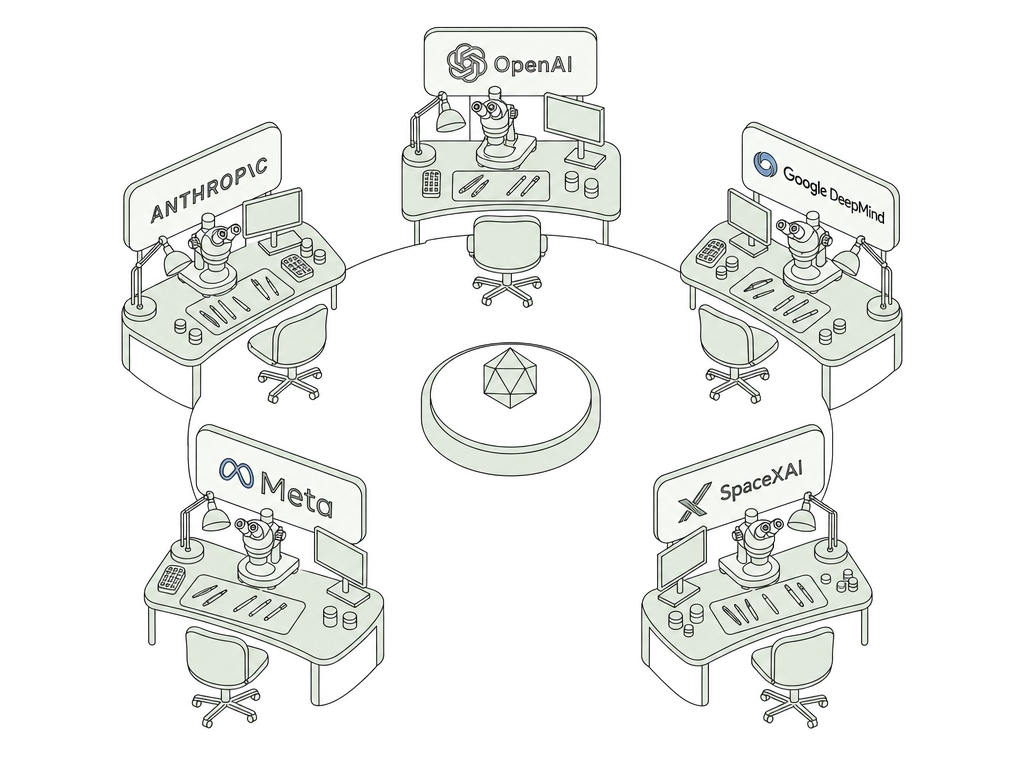
Four frontier-model events landed in just over a week. Anthropic returned Claude Fable 5 to general availability, then OpenAI launched GPT-5.6, SpaceXAI released Grok 4.5, and Meta introduced Muse Spark 1.1 within two days.
Fable 5 remains exceptional and leads Artificial Analysis's current Intelligence Index. GPT-5.6 Sol came within one point while completing tasks in 61% less time at roughly half the estimated cost. Google may answer next: unverified reports suggest Gemini 3.5 Pro could arrive as soon as July 17 with a new pre-training run and a two-million-token context. If those claims hold, Gemini could set a new frontier within days.
The bigger story is that America's credible frontier-model field has expanded from three labs to five. OpenAI, Anthropic, and Google DeepMind were the established group. Grok 4.5 and Muse Spark 1.1 show that SpaceXAI and Meta can also turn enormous compute and research investment into competitive frontier systems.
Three, Maybe Four
Earlier this year, Anthropic CEO Dario Amodei compared frontier AI with cloud computing. Cloud settled around three or four major players. He expected AI to do the same.
The argument was not simply that training costs billions of dollars. A new entrant also needs researchers, data systems, distributed training infrastructure, reinforcement-learning pipelines, evaluations, inference engineering, and the accumulated judgment required to make an enormous run work.
Giving an inexperienced organization $100 billion would not instantly provide that knowledge.
That reasoning still holds. The frontier remains an unusually difficult club to enter. What changed is the count.
The Models Crossed A More Important Line
Frontier status should not come from one company benchmark or one impressive demo. Models vary by task, and their results change with the harness, reasoning effort, and provider runtime.
The more useful test is whether a lab can produce a model that competes across difficult workloads, make it usable in real products, and show enough depth in the underlying stack to do it again.
Grok 4.5 crossed that line. Artificial Analysis gave it a score of 54, a 16-point improvement over Grok 4.3 that placed it directly behind the leading OpenAI and Anthropic systems at the time of testing. Its strongest results were in coding and agentic knowledge work rather than a narrow academic benchmark.
The training details matter as much as the rank. SpaceXAI says the model was trained across tens of thousands of NVIDIA GB300 GPUs, with reinforcement learning covering hundreds of thousands of technical tasks. That is evidence of a functioning training and post-training system, not only access to a large cluster.
Meta's return is different but just as significant. Muse Spark 1.1 is competitive across coding, computer use, multimodal reasoning, and tool orchestration. It can manage a one-million-token context and is available through Meta's first public model API.
Artificial Analysis scored Muse Spark 1.1 at 51. That does not make it the strongest model in every category. It does put Meta close enough to compete for real frontier workloads, at a price and speed that make the model practical to deploy.
The distinction matters. Meta has not merely announced that it intends to return to the frontier. It has released a capable model and the platform needed for developers to use it.
The Moat Did Not Disappear
It would be easy to read five credible labs as evidence that frontier models are becoming easy to build. The opposite is closer to the truth.
Meta and SpaceXAI are two of the few organizations able to combine enormous capital, infrastructure, distribution, and research talent. Their success does not weaken Amodei's description of the moat. It shows that two more organizations have assembled the complete package required to cross it.
SpaceXAI moved from aggressive infrastructure construction to a model that now competes in leading coding and agentic evaluations. Meta converted years of research, a reorganized model effort, and its infrastructure base into a serious proprietary model platform.
These are institutional achievements. A benchmark score is the visible result of a much larger system.
Five Labs Changes The Market
The leading model will keep changing. The structural shift is that more organizations can now challenge for that position.
With three credible suppliers, a capability lead can persist longer and product decisions can harden around one provider. With five, every lab faces more pressure on intelligence, inference speed, price, context, tooling, and distribution. A model does not need to rank first everywhere to change the market. It needs to be strong enough that builders can credibly move important workloads onto it.
We recently argued that AI systems should route the step, not the agent. A five-lab market makes that approach more useful. Coding, research, computer use, visual work, and high-volume execution no longer have to share one permanent model choice. Competition gives product teams more serious options for each part of the work.
The largest AI story this week is therefore not the name at the top of a leaderboard. It is that the number of American organizations capable of reaching that leaderboard has changed.
The frontier moat remains. America now has five labs that have shown they can cross it.